How to Measure Watch Lug Width: A Step-by-Step Guide
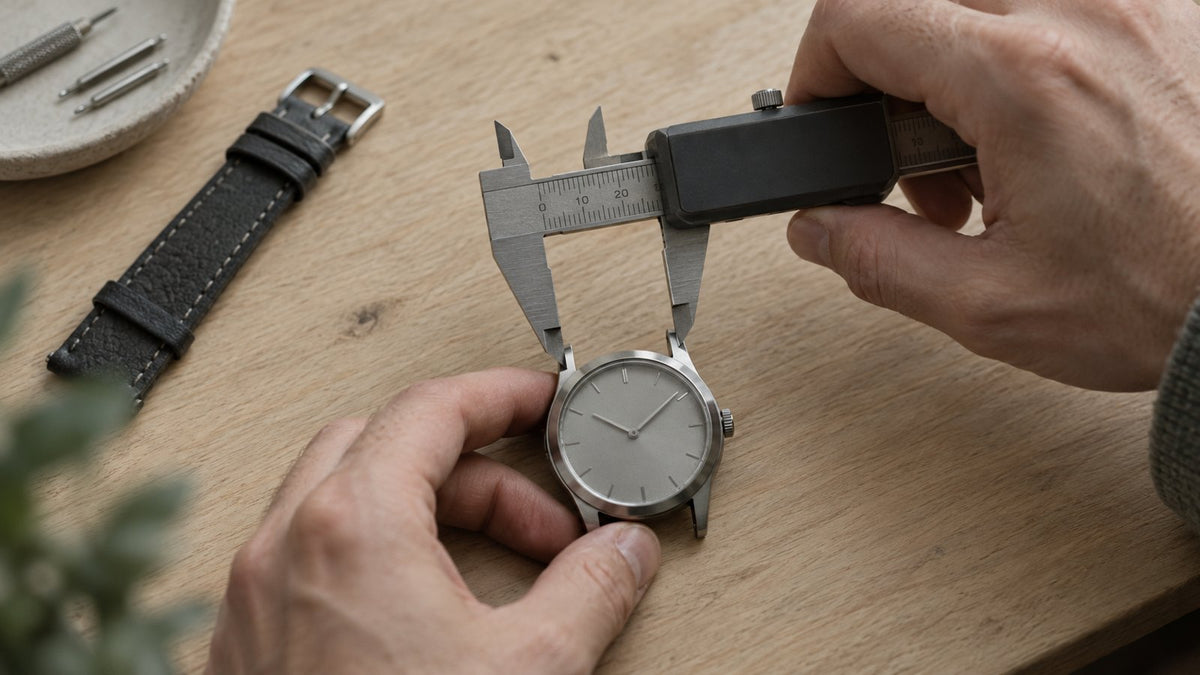
Lug width is the single most important number when you buy a new strap. Get it right and the strap sits flush between the lugs with no gaps and no strain. Get it wrong and the strap either wobbles from side to side or simply will not go in. The good news: measuring it takes a few minutes and very little equipment. This guide walks through three reliable methods, explains the other numbers that often get confused with lug width, and lists the mistakes we see most often.
What lug width actually means
The lugs are the two pairs of "horns" that stick out from the top and bottom of a watch case. A spring bar (or, on some watches, a screw bar) runs between each pair and holds the strap. Lug width is the inside distance between the two lugs of one pair, measured where the bar sits. It is quoted in millimeters, and it is the width your strap needs to be at the end that attaches to the case.
Lug width is not the same as case diameter, lug-to-lug length, or buckle width. We cover those below, because mixing them up is the most common reason a strap does not fit.
What you need
- A digital or dial caliper – the most accurate option and widely available from hardware and hobby suppliers.
- A ruler marked in millimeters – workable if you take your time.
- A soft cloth – to rest the watch on so the case and crystal stay scratch-free.
- A spring bar tool (optional) – only needed if you want to remove the current strap for a cleaner measurement.
Method 1: Measure with a caliper (most accurate)
- Lay the watch face down on the cloth so the lugs point up.
- If you can, remove the strap first. If not, you can still measure – just be careful not to press the caliper jaws into the strap material.
- Open the caliper's inside jaws (the small upper pair) and place them between the two lugs, at the level of the spring bar holes. Avoid measuring at the very tips of the lugs, because many cases flare or taper there.
- Gently open the jaws until they touch both inner faces of the lugs, then read the value.
- Repeat on the other pair of lugs. The two readings should match.
Your reading will usually be very close to a whole number such as 18.0, 20.0 or 22.0 mm. If it lands slightly under a whole number – for example 19.8 mm – the watch is almost certainly designed for the next whole size up, because strap ends are cut to nominal sizes and compress a little as they seat.
Method 2: Measure with a millimeter ruler
- Remove the strap if possible so nothing blocks the view.
- Hold the ruler flat across the gap between one pair of lugs, at the spring bar holes.
- Line up the zero mark with the inner face of one lug and read where the inner face of the other lug falls.
- Look straight down at the ruler rather than at an angle, which can throw the reading off by a millimeter.
- Take two or three readings and use the one you get most often.
A ruler is perfectly adequate for telling 18 mm from 20 mm. It is less reliable for spotting odd sizes such as 19 mm or 21 mm, so if your reading falls between two sizes, double-check with a caliper before you order.
Method 3: Measure the strap you already have
If the current strap fits well, its width at the lug end tells you the lug width. Remove it, lay it flat, and measure straight across the end that attaches to the case – not the narrower end near the buckle. Many straps also have the width printed or stamped on the underside, often written as two numbers such as "20/18". The first number is the lug end; the second is the buckle end.
This method only works if the existing strap is the correct size. If it has visible gaps beside the lugs or looks squeezed, measure the watch itself instead.
Odd sizes and "in-between" readings
Even sizes – 18, 20 and 22 mm – are the most common, but 19 mm and 21 mm lug widths exist on plenty of watches. Do not assume your watch is an even size; measure it.
Occasionally a case measures a fraction under its nominal size. A well-known example is the Blancpain × Swatch Scuba Fifty Fathoms: independent measurements put its lug gap at roughly 21.7 mm, yet straps for it are cut at 22 mm and seat snugly. When a reading lands a few tenths under a whole number, the next whole size up is usually correct. When it lands right in the middle (say 20.5 mm), check the watch maker's published specifications before buying.
Numbers that are often confused with lug width
- Case diameter – the width of the case itself, typically measured without the crown. Two watches with the same case diameter can have different lug widths.
- Lug-to-lug – the distance from the tip of the top lugs to the tip of the bottom lugs. It tells you how the watch will sit on your wrist, not what strap width to buy.
- Buckle width – many straps taper toward the buckle, for example from 20 mm to 18 mm. This is a style choice and does not affect fit at the case.
- Spring bar diameter – the thickness of the bar. Most straps accept standard bars, but some cases use thicker bars or screw bars. Check this if your watch uses anything other than ordinary spring bars.
Straight-end vs. curved-end straps
Lug width tells you how wide the strap must be, but not how the end is shaped. A straight-end strap works on almost any watch with the right lug width and leaves a small gap between the strap and the case. A curved-end (or "fitted") strap is shaped to follow the curve of one specific case, closing that gap. Curved-end straps are model-specific, so for those you need both the correct lug width and confirmation that the strap is compatible with your exact watch model.
Common mistakes to avoid
- Measuring at the outer edges of the lugs instead of the inside gap.
- Measuring at the lug tips, where many cases flare.
- Reading the buckle end of the old strap instead of the lug end.
- Rounding an odd size such as 19 mm down to 18 mm "because it is close" – a 1 mm gap is clearly visible and lets the strap shift.
- Forcing a strap that is 1 mm too wide. This can scratch the lugs and bend the spring bar.
Using your lug width to shop
Once you have your number, you can filter by width. Browse our 20 mm straps or 22 mm straps, or see all straps. If you own a model with a fitted, curved-end option – such as straps compatible with the Omega × Swatch MoonSwatch or the Blancpain × Swatch Scuba Fifty Fathoms – start with the model-specific collection instead, and check the lug width listed on each product page.
Quick FAQ
Can I fit a 20 mm strap on a 21 mm watch? It will go in, but it will leave a visible gap and can slide along the spring bar. We recommend matching the lug width exactly.
Does lug width change between the top and bottom of the watch? On nearly all watches the two pairs are identical. Measuring both is a quick sanity check.
Do I need to remove the strap to measure? Not always, but removing it gives the clearest reading, especially with a ruler.
Brand and model names are used only to describe compatibility. Lugline is an independent brand with no affiliation to any watch manufacturer.